




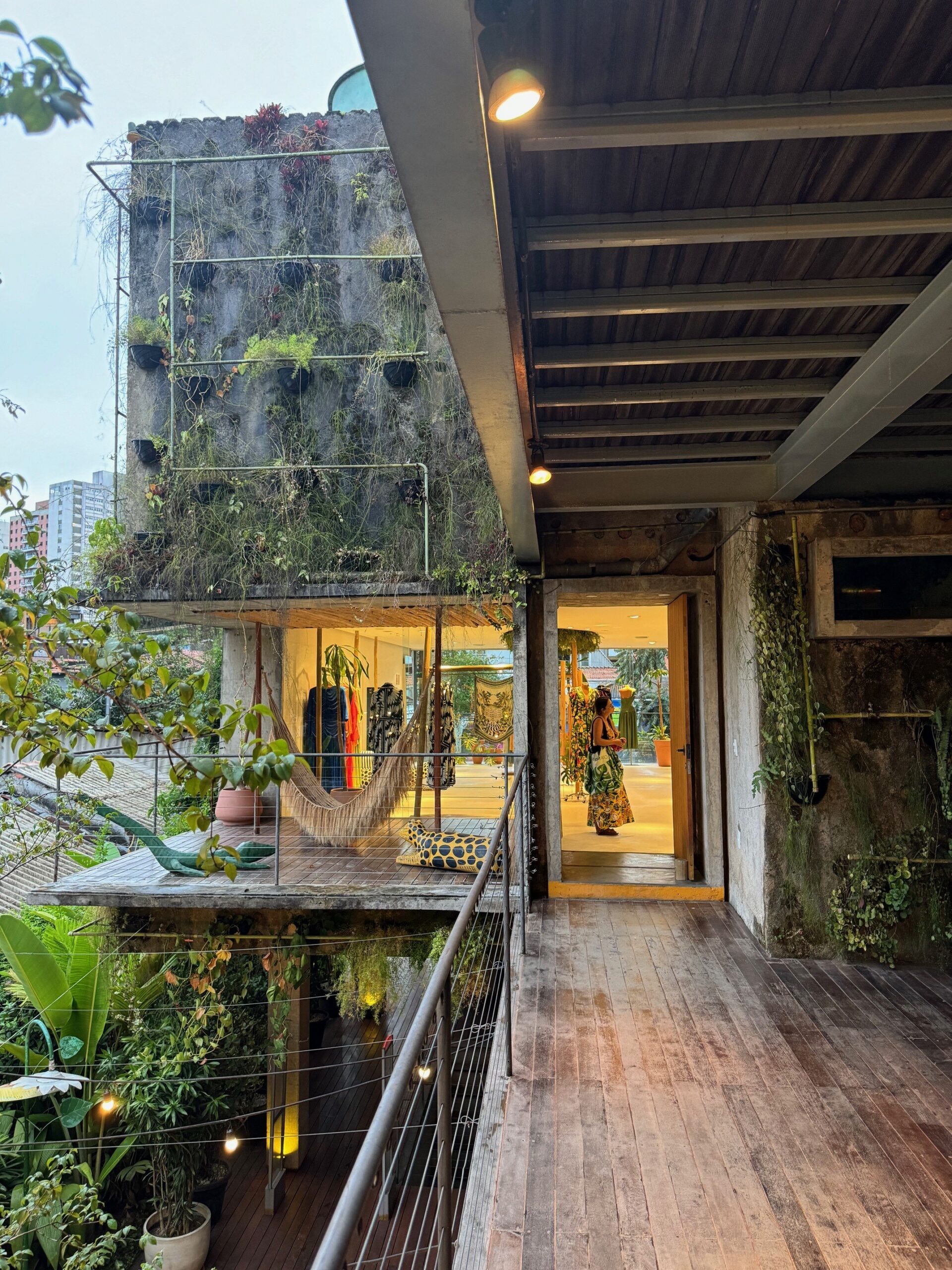
Large-leafed climbers, aggressive vines, and dense vegetation thrive in tropical and subtropical environments, where heat, humidity, and consistent daylight create ideal conditions for rapid growth. In these regions, some of the most interesting buildings are designed with the expectation that they will eventually become partially, if not almost completely, covered in foliage.
The visual contrast is striking: bold, monolithic concrete forms softened by lush, fast-moving greenery. This is not simply the accidental beauty of vines covering a ruin. It is an architectural approach in which living plants become part of the façade, ornamentation, and experience of the building.
This emerging design language is often described as eco-brutalism.
Eco-Brutalism and the Architectural Power of Plants
Traditional Brutalist architecture is associated with exposed concrete, monumental forms, structural honesty, and minimal ornamentation. Eco-brutalism retains that architectural weight but introduces living systems as a counterpoint. Concrete provides permanence; vegetation introduces movement, softness, and change.
In many parts of South and Central America, vegetation is not treated as decoration applied after construction. It is considered part of the architectural composition from the beginning. While there is no formally defined category called “tropical brutalism,” this approach exists at the intersection of tropical modernism and the evolving conversation around eco-brutalism, where raw materials and living systems are designed to coexist.
Architects Who Composed Buildings and Landscape Together
Architect Luis Barragán demonstrated how architecture and landscape can be composed as a unified experience. His gardens, walls, courtyards, water features, and carefully framed views show how plant life can define both space and atmosphere.
Similarly, Paulo Mendes da Rocha, a leading figure in Brazilian Brutalism, embraced the relationship between structure and environment. Although his buildings are frequently defined by strong, exposed concrete forms, they respond to climate, topography, and their surroundings. His work reinforces the idea that architecture does not have to stand apart from nature; it can be embedded within it.
More contemporary architects, including Marcio Kogan and Studio MK27, extend this philosophy into modern tropical design. Their projects pair exact architectural lines with abundant vegetation, creating spaces that feel controlled and immersive at the same time. In projects such as Paraty House and Jungle House, tropical vegetation does not merely surround the architecture, it visually envelops and transforms it.
Across these examples, a consistent theme emerges: buildings are conceived not as static objects, but as frameworks that interact with living systems over time.
Plants as an Architectural Material
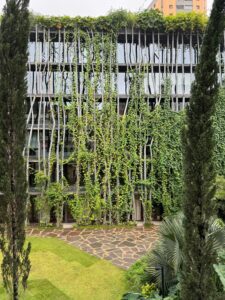
Climbing plants play a particularly important role in this relationship. Unlike trees or ground-level plantings, vines directly engage with walls, columns, trellises, beams, and other structural elements. The architecture itself becomes a host for growth.
As climbing plants mature, they reshape the visual identity of a building. Hard edges become softened. Blank walls acquire texture and depth. Permanent materials begin to display movement, irregularity, and seasonal change.
This is what makes the combination so compelling. Concrete, stone, and steel communicate strength and permanence. Plant life expresses change and adaptation. One is fixed; the other is continuously growing.
Rather than concealing Brutalist architecture, plants can help reveal its character. The weight and texture of concrete become more noticeable when contrasted with delicate stems and foliage. In return, the raw architecture gives vegetation greater visual authority. Plants stop functioning as accessories and begin to read as part of the structure.
Bringing Eco-Brutalism Indoors in Northern Climates
In northern climates, the tropical expression of eco-brutalism can be brought indoors.
Atriums, conservatories, glass-enclosed rooms, and interiors with strong natural light can support plants growing across walls and architectural structures throughout the year. When natural daylight is insufficient, properly designed supplemental lighting can create the conditions necessary for sustained growth.
The result is a hybrid environment: the permanence of architecture combined with the adaptability of a living system.
Concrete walls, steel beams, and architectural columns provide the structural foundation. Tropical vines introduce softness, movement, and visual continuity. Plants can be trained to climb, cascade, frame openings, define pathways, or divide large interior spaces.
Interior Conditions You Can Control
The advantage of bringing this concept indoors is control:
- Light can be supplemented and extended.
- Irrigation can be managed precisely.
- Temperature and humidity can be moderated.
- Growth can be directed through pruning and training.
- Maintenance can be scheduled and performed consistently.
This makes it possible to create a curated version of eco-brutalism, one that retains the visual drama of nature overtaking architecture while reducing the unpredictability of exterior growing conditions.
Eco-Brutalism at the Planterra Conservatory
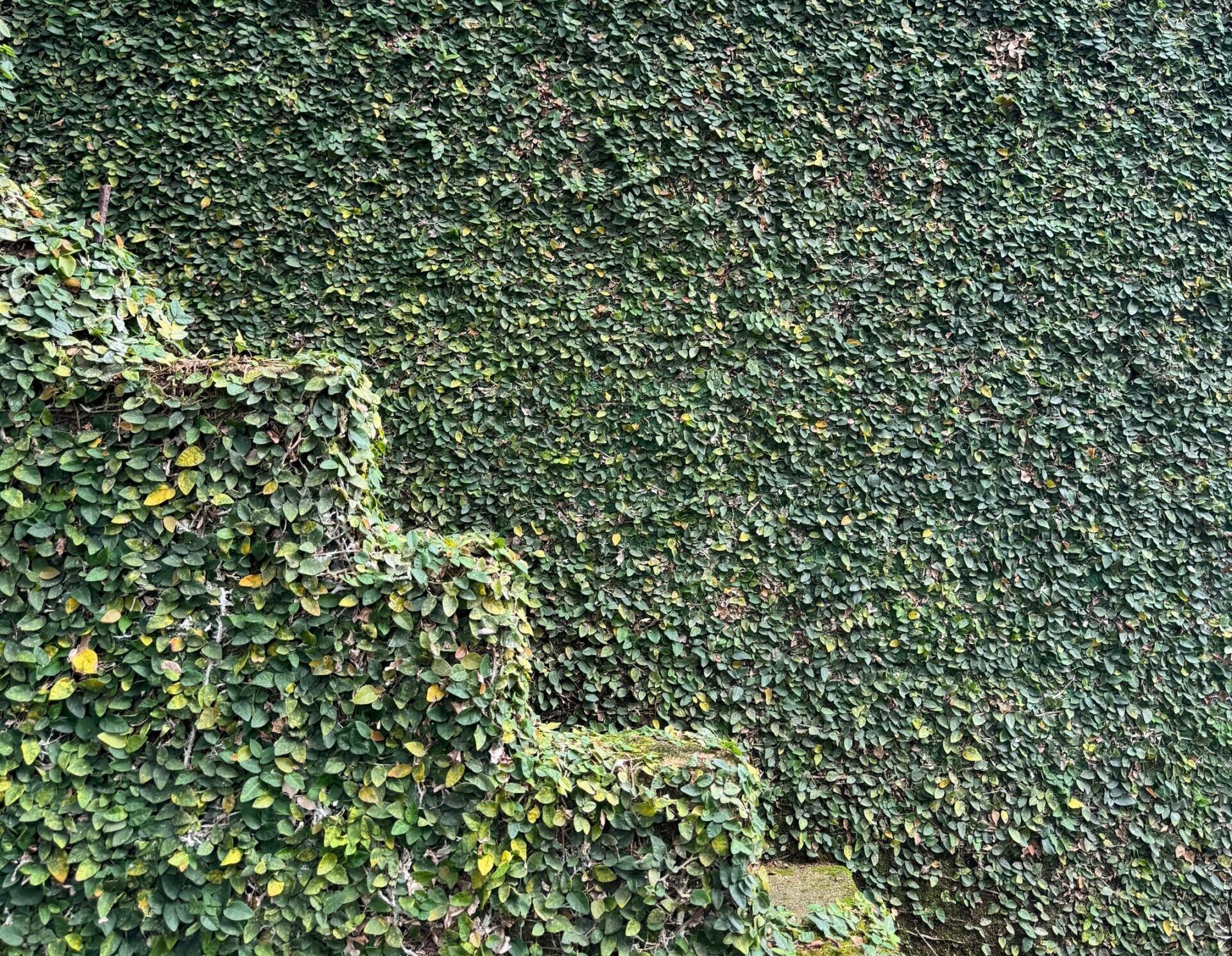
At the Planterra Conservatory, this principle is brought to life through the use of creeping fig (Ficus pumila) and Algerian ivy (Hedera canariensis).
Creeping Fig as a Living Wall Surface
Creeping fig attaches itself directly to concrete surfaces, creating a dense green layer that gradually transforms the wall into a living material. Instead of placing foliage in front of the architecture, the plant becomes part of the architecture.
Algerian Ivy as Spatial Division
Algerian ivy is trained across trellises to define space, most notably between the Conservatory’s ceremony and reception areas. In this application, the plants are not merely ornamental. They perform a spatial function similar to a wall, screen, or architectural partition, while remaining softer and more dynamic.
Designing for the Mature Condition
These installations also demonstrate an important practical lesson: architectural planting must be designed for its mature condition. Plant selection, attachment method, irrigation, lighting, drainage, pruning access, and long-term maintenance all need to be considered before installation. A successful planting is not simply one that looks good on opening day. It must be able to develop gracefully and remain maintainable for years.
From Interior Plants to Living Architecture
Eco-brutalism offers a useful way to think about the future of indoor landscaping. It moves the conversation beyond adding planters to a finished room. Instead, plants can be considered alongside walls, columns, lighting, circulation, and furnishings from the earliest stages of design.
This does not mean every interior needs to become a jungle. A single vine trained across a concrete wall can establish the relationship. So can a living wall positioned as a major architectural feature, a group of large tropical specimens beneath a structural canopy, or a planted screen used to divide space.
The defining principle is intentionality: the plants and the architecture should appear to belong to one another.
For architects, interior designers, developers, and facility professionals, this requires early collaboration with an experienced interior landscape partner. Plant selection is only one part of the process. The supporting systems must also be designed around the realities of light, water, drainage, growth, access, and ongoing horticultural care.
When those elements are considered together, indoor landscaping becomes more than decoration. Plants can soften the severity of raw materials, create human scale within monumental spaces, direct movement, improve the experience of a room, and give an otherwise static interior a sense of life.
That is the enduring appeal of eco-brutalism: architecture provides the framework, but nature is allowed to complete the composition.
Design Eco-Brutalism Into Your Space
Eco-brutalism works best when the plants and the architecture are planned together from the start, not added at the end. Planterra’s design-build team collaborates with architects, designers, and developers to create living architecture that is built to mature gracefully and stay maintainable for years. Plan your space with Planterra.
Related Articles
Climbing Plants That Add Height and Movement to Indoor Spaces
Green Walls in Architecture: Systems, Performance, and Specification Strategy
Biophilia in Architecture: A Guide for Modern Commercial Spaces