



Few plants have spent as long in the spotlight as the philodendron. It has shown up in Paris salon paintings, mid-century living rooms, 1970s macramé hangers and today’s hotel lobbies, and it still looks current every time.
The name comes from the Greek philo (love) and dendron (tree), a nod to the way many species climb up tree trunks in the rainforests of Central and South America. The genus holds several hundred species, and growers have added countless cultivars. For designers, that range is the point: there is a philodendron for almost every scale, light level and mood.
After more than five decades of placing plants in offices, hospitals, hotels and homes, these are the types of philodendron plants we keep coming back to, and the story of how they became a design icon.
Five Popular Philodendrons with Real Style
These are the philodendron varieties that earn their place in a design scheme, from sculptural floor specimens to soft trailing vines.
1. Split-leaf Philodendron (Philodendron Bipinnatifidum)
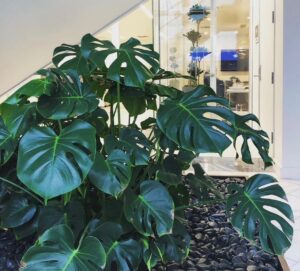 This is the architect’s philodendron. Its deeply cut, glossy leaves can reach three feet long, held on a thick, tree-like stem marked with leaf scars and aerial roots. Native to Brazil, Argentina and Paraguay, it was a staple of mid-century modern interiors and still reads as instantly sculptural. Botanists moved it to the genus Thaumatophyllum in 2018, and older references call it Philodendron selloum, but the trade still knows it as split-leaf philodendron.
Design inspiration: Give it room. A mature plant spreads six feet or more, so treat it as a living sculpture in a lobby, atrium or double-height space. Where live plants aren’t practical, an artificial Philodendron Selloum gives the same silhouette. For a tighter footprint, its compact cousin Philodendron Xanadu offers the same cut leaf at about half the size.
2. Monstera (Monstera deliciosa)
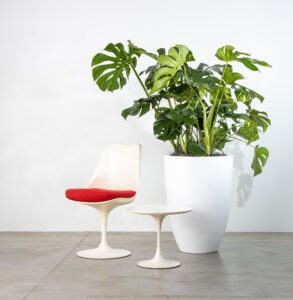 The Philodendron Monstera, also called the Swiss cheese plant, is the most photographed leaf of the last decade. Its fenestrations (the natural holes and splits in mature leaves) have become shorthand for tropical modernism on wallpaper, textiles and tableware. For years it was also sold as a split-leaf philodendron. Botanically, it is a close cousin in the same aroid family rather than a true philodendron, but it belongs in any conversation about the look. It is native to the tropics of Central America and sends out aerial roots as it grows.
Design inspiration: Use it where you want a graphic silhouette. Against a plain wall, its shadow alone does design work.
3. Heartleaf Philodendron (Philodendron hederaceum)

The classic trailing vine with soft, heart-shaped leaves and a rich green color that works beautifully in almost any indoor setting. Known for its adaptability and easy care, the Heartleaf Philodendron is one of the most forgiving houseplants around. It was also a defining plant of the 1970s houseplant boom, when its long, leafy vines became a familiar sight spilling from shelves, hanging baskets, and plant stands. Today, it remains a popular choice for adding natural greenery to homes and offices without requiring much maintenance.
Design inspiration: Use it to introduce movement and softness into a space. Let its vines cascade from bookcases, millwork, and high shelving, or train it up a moss pole for a more vertical display. Its trailing growth also makes it a great option for softening sharp architectural lines and bringing greenery into spaces where floor space is limited.
4. Philodendron ‘Brasil’
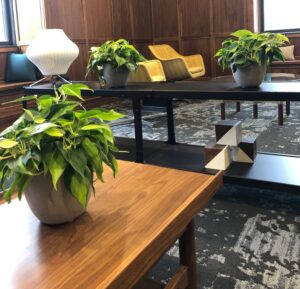
A colorful variation of the classic heartleaf, Philodendron Brasil features striking lime to golden-yellow variegation running through the center of its dark green, heart-shaped leaves. Named for its resemblance to the colors of the Brazilian flag, this variety offers the same easy-care nature and trailing growth habit as the traditional heartleaf, but with added color and personality. Its long, cascading vines create a lively display, making it a popular choice for homes and offices that could use a little extra greenery and visual interest.
Design inspiration: Pair it with warm woods, brass finishes, and green or ochre color palettes that complement its natural variegation. Display it on open shelving, in hanging planters, or along elevated ledges where its colorful vines can trail freely. Its mix of light and dark greens also makes it a great choice for brightening neutral interiors and adding contrast without overwhelming the surrounding design.
5. Philodendron ‘Rojo Congo’
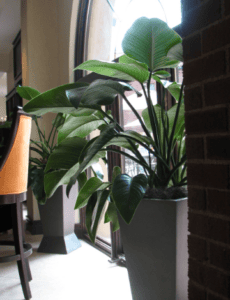
The Philodendron Congo family of modern hybrids, including ‘Rojo Congo,’ has a bold, upright habit. These plants are “self-heading,” meaning they grow in a tight clump and need no pole or support. In ‘Rojo Congo,’ new leaves open in deep red and burgundy before maturing to dark green, so the plant always shows two tones at once. Its large, glossy leaves hold their shape well, and the plant stays compact in a planter with little grooming.
Design inspiration: A tidy, architectural choice for planters at reception desks, conference rooms and hospitality spaces where a climbing plant would look unkempt. The red new growth also adds a warm accent against wood and neutral finishes.
The Philodendron in Art
Long before Instagram, painters understood what a big tropical leaf could do to a composition. Two artists in particular shaped how we still see these plants.
Henri Rousseau: The Jungle He Never Saw
Henri Rousseau, nicknamed “Le Douanier” for his day job as a Paris toll collector, painted lush jungles but never left France. He built his rainforests from visits to the glasshouses of the Jardin des Plantes in Paris, sketching the tropical plants growing there. In works like Surprised! (1891) and The Dream (1910), giant split and lobed leaves crowd the canvas, layered in dozens of greens.
What designers can take from Rousseau is layering. He stacked leaves of different sizes and shades in front of one another to create depth, which is exactly how a well-composed plant grouping works in an interior.
Henri Matisse: The Leaf as Pure Shape
Henri Matisse traveled to Tahiti in 1930, and the tropical forms he saw there resurfaced years later in his paper cut-outs of the 1940s and 1950s, such as Oceania, the Sky (1946). In those works, leaves and seaweed become flat, bold silhouettes cut straight from painted paper. His late studio in the south of France was filled with large-leaved tropical plants.
Matisse showed that a single leaf shape, repeated and simplified, can carry a whole room. That idea runs straight through to today’s Monstera wallpapers, rugs and textiles.
A Short Design History of the Philodendron
The philodendron has gone in and out of fashion with every major design movement of the last 75 years, and it has never stayed out for long.
Mid-Century Modern (1950s–60s)
Open plans, floor-to-ceiling glass and low furniture needed plants with architecture of their own. The split-leaf philodendron and Monstera became the signature plants of the era. The Monstera was a favorite of Charles and Ray Eames, whose interiors helped make big tropical foliage part of the modernist look.
The 1970s Houseplant Boom
Plants moved from statement pieces to everywhere at once. The heartleaf philodendron trailed from macramé hangers, bookshelves and kitchen windows, and plant shops became a fixture of city neighborhoods.
Corporate Atriums (1980s–90s)
As office towers and hotels added soaring atriums, large philodendrons scaled up with them. This is when commercial plantscaping, the work Planterra has done since 1973, became a standard part of building design.
Today’s Revival
Social media turned the Monstera leaf into a pattern on everything from wallpaper to sneakers, and biophilic design gave plants a place in the brief, not just the finishing touches. Collectors now chase rare variegated cultivars, while designers lean on the classics for their reliability and silhouette.
About That Fruit
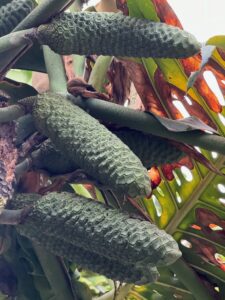
Yes, it looks exactly like what you’re thinking. We’ll let the photo speak for itself and stick to the botany.
Philodendrons and their aroid cousins flower with a spathe, a hooded leaf, wrapped around a spadix, a thick upright spike packed with tiny flowers. The split-leaf philodendron goes a step further: its spadix can heat itself well above the surrounding air at night, releasing scent that draws in the beetles that pollinate it.
The Monstera’s spadix ripens into an edible fruit that can take up to a year to mature and tastes something like pineapple and banana. Patience matters here, because unripe fruit contains irritating crystals. Indoors, flowering is rare and usually limited to mature plants in bright conditions, so if one appears, consider it a sign of very good care.
Choosing the Best Philodendrons For Your Next Project
The best philodendrons for a space depend on the role you want them to play: sculpture, softness, color or structure. Split-leaf and Monstera make the statement, heartleaf and ‘Brasil’ add movement, and Congo hybrids keep things crisp. Between them, these types of philodendron cover nearly every design brief.
If you’re specifying plants for a lobby, office, hotel or home, our team is happy to help you match the right philodendron types to your light, scale and style. Browse our plant catalog to see what’s available.