






Presented at NeoCon 2026: Wellness-Driven Interiorscapes for Sustainable Design
Designers have always known their work affects people. What’s changed is that science can now explain exactly why; and that explanation is reshaping what clients expect, what buildings need to deliver, and what it means to do your job well.
I’ll be presenting on this at NeoCon 2026, and I want to give you a preview of what we’ll cover, because the research is too important to save for a single hour in Chicago.
The session is called Wellness-Driven Interiorscapes for Sustainable Design, and it connects three things the design industry has been moving toward separately: the neuroscience of how environments affect human performance, the biophilic design frameworks that give you a working vocabulary for acting on that science, and the practical question of how living plants deliver those outcomes inside real buildings.
Here’s the short version. Then I hope you’ll come get the full one.
The Brain Doesn’t Just See a Room. It Responds to One.
Neuroaesthetics is the scientific study of what the brain actually does in the presence of aesthetic stimuli. Two researchers have been particularly influential in bringing this into the design conversation.
Anjan Chatterjee, founding director of the Penn Center for Neuroaesthetics, reframed aesthetic response as something the brain does, not a passive impression, but an active neurological event. Susan Magsamen, director of the International Arts + Mind Lab at Johns Hopkins, extended that work into applied health outcomes through her 2023 book Your Brain on Art. Her definition of an aesthetic experience: any encounter with an object, a space, a sound, an image that activates the senses deeply enough to alter how we feel, think, and are.

The mechanisms are documented through neuroimaging and physiological measurement. Aesthetically rich environments activate the brain’s reward structures and shift cognitive processing away from high-load executive regions, the parts of the brain that drain people. They engage the default mode network, associated with reduced mental effort, improved neural efficiency, and the kind of diffuse thinking linked to creativity and insight. They measurably reduce cortisol. Cortisol reduction has been observed after as little as 45 minutes in an aesthetically significant environment.
Chatterjee adds one more dimension that should matter to every commercial designer: aesthetically rich environments reduce the drain on executive function over time. People sustain focus longer. They hit the wall later. Environment isn’t backdrop. It’s input. What surrounds people directly shapes what they’re capable of.
Why Modern Buildings Are Making Us Work Harder Than We Should
A 2026 study published in Discover Cities (Springer) analyzed 77 building façades across five architectural periods in Seoul, measuring neurophysiological responses at multiple viewing distances. The finding: historic architecture produces measurably lower visual stress than modern high-density façades.
The mechanism is neurological. Contemporary façades (high contrast, repetitive geometric patterns, reflective glazing) create cortical hyperexcitability. The visual cortex is working harder than it is evolutionarily adapted to work. Historic façades, rich in craft detail and organic surface variation, align with how the brain is actually built to process information.
That level of hand-crafted detail is not coming back at scale. It’s neither economically viable nor logistically practical to reintroduce organic surface variation through architecture alone.
Nature Is Not a Trend. It’s an Evolutionary Baseline.
Both Chatterjee and Magsamen return to nature repeatedly in their research; not as metaphor, but as evidence. Across cultures and contexts, natural environments activate the brain’s reward, restoration, and stress-recovery systems more reliably than any other aesthetic category.
E.O. Wilson explained why in 1984: we evolved in nature. Our nervous systems are calibrated to it. Removing it from our environments doesn’t make us neutral. It creates a deficit.
Environmental psychologists Rachel and Stephen Kaplan identified the mechanism through Attention Restoration Theory: directed attention (the focused cognition we use for sustained work) is a finite resource that fatigues with use. Natural environments uniquely offer what they called “involuntary attention” — the gentle, effortless noticing engaged by organic movement, living complexity, and natural form. It allows depleted attention to recover without demanding cognitive effort. It is neurological rest.
Roger Ulrich’s Stress Recovery Theory adds the physiological layer: exposure to natural environments triggers an automatic downregulation of the stress response (reduced heart rate, lower blood pressure, normalized skin conductance) within minutes, consistently, across cultures and demographics. The original evidence: surgical patients with window views of nature had shorter hospital stays, required less pain medication, and recovered faster than patients whose windows faced a brick wall.

What the Research Shows When You Put Plants in a Room
The science isn’t only theoretical. It’s being tested in controlled settings, and the results are consistent.
A 2021 study at the University of Reading tracked 40 office workers over six weeks. When plants were introduced at workstations, creativity improved significantly (p = 0.019), attention improved significantly (p = 0.018), productivity improved significantly (p = 0.023), and overall workplace satisfaction increased significantly (p = 0.004). When plants were removed (even just moved to common areas) those gains reversed. The data doesn’t just demonstrate benefits. It demonstrates the cost of absence.
A Texas A&M study placed 188 participants in a stress-inducing simulated healthcare scenario, then exposed them to hospital rooms varying three biophilic elements: living plants, window views of nature, and green-toned decor. Living plants ranked first on both restoration outcomes. Here’s the detail that should stop you: the entire study was conducted in VR. Participants responded to the image of a plant and still produced measurable stress recovery. Designers working with real plants in real environments have access to everything that simulation was missing: humidity, oxygen exchange, movement, scent, life.
And at the built-environment scale: Etsy’s global headquarters in Brooklyn, designed by Gensler, installed over 11,000 plants across 200,000 square feet. Every employee was guaranteed a sightline to greenery from their seated position; planned at schematic design stage, not retrofitted. A 3,400-gallon rainwater cistern was engineered specifically to irrigate the living walls. The building achieved indoor air quality that tested better than outdoor air.

The Certification Landscape Has Caught Up
This is no longer a values conversation. It’s a documentation conversation.
LEED v5, launched in April 2025, elevated biophilic design from an optional pilot credit to a core credited strategy worth up to 7 points under the EQ Credit: Occupant Experience. Stephen Kellert’s five principles are now the documentation framework. WELL v2’s Mind Concept requires restorative spaces with living plants, occupant sightlines to nature from regularly occupied positions, and a formal biophilia plan at each design stage — making early collaboration with a plantscaping specialist a certification requirement, not best practice.
Both frameworks reward the same thing: biophilic design that’s integrated from the start, not specified at the end.
What I Want You to Walk Away With at NeoCon
The full session will go deeper on all of this — the 14 Patterns of Biophilic Design, what each certification framework actually requires from plant specification, common integration failure modes and how to avoid them, and a practical framework for collaborating with horticultural expertise from schematic design forward.
But the core argument is already in front of you:
The science doesn’t tell us to add plants. It tells us what we’ve been missing by leaving them out.
I’ll see you at NeoCon.
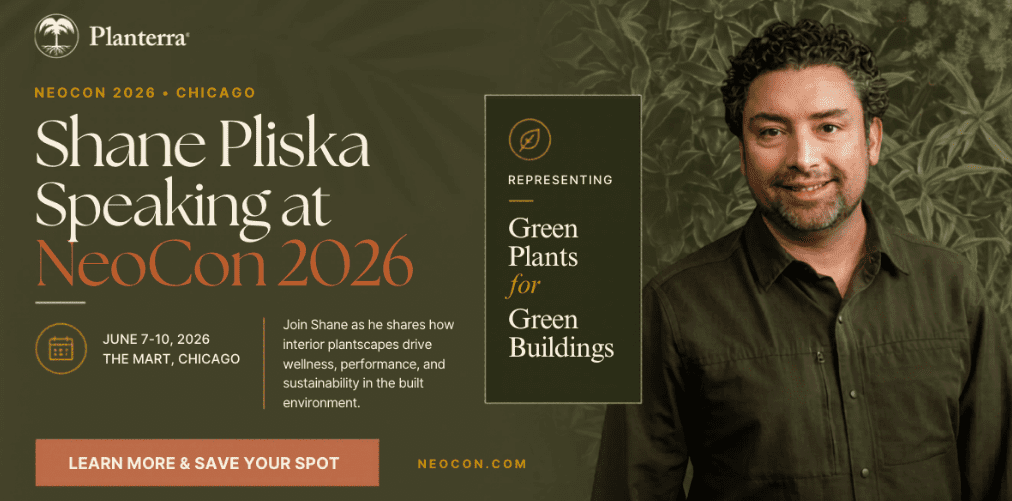
Shane Pliska is President & CEO of Planterra, a national leader in interior plantscaping serving commercial clients across the U.S. and Canada. planterra.com