




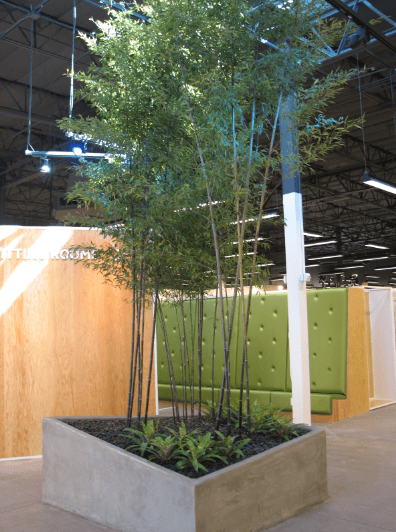
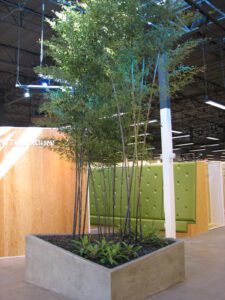
 The bamboo palm is a palm, not a bamboo.
Its botanical name is Chamaedorea seifrizii, and it belongs to the palm family, Arecaceae. The confusion comes from its slender, ringed trunks, which grow together in clusters and strongly resemble bamboo canes. This resemblance gives the bamboo palm its common name, although the two plants are botanically quite different.
For interior designers, that distinction may be less important than the visual result. The bamboo palm combines the lightness and vertical rhythm of bamboo with the soft, feathery foliage of a tropical palm. This is one reason we frequently use bamboo palms in commercial interior landscaping.
What Makes a Bamboo Palm a Palm?
True bamboo belongs to the grass family, Poaceae. Although some bamboo species grow to the size of trees, their jointed stems are technically giant grass culms. Bamboo generally spreads through underground rhizomes and produces long, narrow leaves from branching stems.
The bamboo palm belongs to an entirely different botanical family. Like other palms, it produces pinnate fronds composed of multiple leaflets arranged along a central stem. Each frond of a bamboo palm typically contains approximately 10 to 14 narrow, feathery leaflets.
Its clustered trunks are what create the confusion. They are slender, upright and marked by rings that resemble the nodes of bamboo. New stems emerge from the base of the plant, gradually forming a dense, architectural grouping.
The bamboo palm is also known as the reed palm, another name inspired by its tall, cane-like growth.
| Bamboo palm | True bamboo |
|---|---|
| A member of the palm family | A member of the grass family |
| Produces feathery palm fronds | Produces narrow leaves from branching culms |
| Forms a slowly expanding cluster | Many varieties spread through rhizomes |
| Adapts to moderate indoor light | Usually requires brighter light indoors |
| Relatively practical to maintain | Can require frequent cleanup and root management |
| Primarily used as an indoor foliage plant in colder climates | Often grown outdoors or used seasonally indoors |
Why Does the Bamboo Palm Work So Well Indoors?
The bamboo palm naturally grows beneath the forest canopy in tropical and subtropical regions. Its ability to live with filtered sunlight makes it particularly well suited to commercial interiors, where direct natural light is limited.
It can tolerate medium indirect light, although the plant will usually grow more slowly and may become less dense. Excess water is often more damaging than slightly dry soil because persistently saturated roots can lead to root or stem rot.
Under good interior conditions, a bamboo palm can reach approximately six to eight feet in height. Its upright growth makes it large enough to have visual presence without requiring the broad footprint of many other tropical specimen plants.
Bamboo Palm Versus True Bamboo Indoors
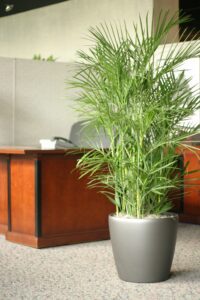 Although true bamboo can be grown in containers, it is generally more difficult to maintain as a permanent interior plant.
Most bamboo requires abundant light, consistent moisture and adequate humidity. In a typical commercial interior, it may develop brown leaf tips, thin foliage or shed large numbers of small leaves. Those fallen leaves can create an ongoing housekeeping issue around planters, flooring and furnishings.
True bamboo also grows from rhizomes. In containers, its vigorous roots can quickly become crowded, requiring periodic division or repotting. Running varieties are particularly aggressive and require careful containment.
A bamboo palm is usually the more practical living plant for an interior landscape. It provides the height, clustered canes and vertical rhythm associated with bamboo but adapts more readily to moderate indoor light. Its larger palm leaflets are also easier to maintain than the numerous small leaves produced by true bamboo.
This is an important distinction for commercial interior designers. A plant may create the desired appearance on installation day, but it must also remain attractive and manageable over time.
What Types of True Bamboo Are Used Indoors?
Several true bamboo species can be grown in containers and used indoors, particularly in bright atriums, conservatories and spaces with large windows. These include:
- Arrow bamboo (Pseudosasa japonica): An upright bamboo with broad, dark-green leaves. It is one of the more practical true bamboos for containerized screening, but it still requires good light and consistent watering.
- Hedge bamboo (Bambusa multiplex): A clumping bamboo available in several compact forms. Its dense foliage makes it useful for screens, although it performs best in very bright interiors or conservatory conditions.
- Buddha belly bamboo (Bambusa ventricosa): Known for the swollen sections that can develop along its canes. It has a distinctive sculptural quality but requires warmth and strong light to perform well indoors.
- Golden bamboo (Phyllostachys aurea): Recognized by its golden-green canes. It can be grown in containers but is better suited to bright atriums or seasonal indoor use than conventional office conditions.
- Black bamboo (Phyllostachys nigra): Valued for its dark, nearly black mature canes. It creates a dramatic architectural effect, but its high light requirements and running growth habit make it a demanding choice for permanent interiors.
“Lucky bamboo” should not be included on this list. Despite its common name, lucky bamboo is Dracaena sanderiana. It is neither a true bamboo nor a palm.
When Faux Bamboo Is the Better Choice
If the design specifically calls for recognizable bamboo canes rather than simply a bamboo-like silhouette, high-quality faux bamboo may be the best option.
Artificial bamboo can maintain a precise height, density and form without leaf drop, aggressive root growth or declining foliage. It is especially practical in low-light areas, narrow planters, inaccessible locations and spaces where housekeeping standards are exacting.
At Planterra, we believe the decision should begin with the design intent and the environmental conditions of the space. Where a living plant can thrive, a bamboo palm provides a practical way to achieve much of bamboo’s visual character with the softness and movement of living palm foliage. Where the exact look of true bamboo is essential, but the environment cannot support it, artificial bamboo may produce the most successful long-term result.
The goal is not to specify a living plant at any cost. It is to select the material that will continue to serve the design after installation.
How Planterra Uses Bamboo Palms in Interior Landscapes
At Planterra, we often use bamboo palms where a designer wants height, movement and a sense of enclosure without creating a heavy visual barrier.
Placed individually, a bamboo palm can soften a corner, add foliage beside a seating area or provide a vertical counterpoint to lower plantings. Used in groups, bamboo palms can function almost like a living screen.
They are particularly useful for:
- Defining seating areas in open offices
- Creating separation between hospitality spaces
- Softening glass partitions and architectural columns
- Screening less attractive views
- Adding height beneath atriums and tall ceilings
- Introducing tropical character without overwhelming the architecture
The plant’s multiple canes create a strong vertical pattern, while its arching fronds allow light and partial views to pass through. The effect is more graceful than a solid partition and less formal than a hedge.
For commercial interior designers, that balance is valuable. The bamboo palm can define space without closing it off.
A Softer Form of Architectural Screening 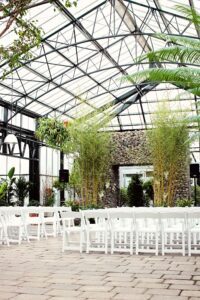
Plants are often treated as decorative objects added after the interior has been designed. The bamboo palm is more effective when it is considered part of the spatial plan.
A row of bamboo palms can create a transitional edge between circulation and seating. Several large specimens can make a lounge feel more private without constructing another wall. In a hospitality setting, their foliage can soften the experience of sitting near a busy walkway while preserving visibility and natural light.
Containers also influence how the plant reads within a space. A tall architectural planter emphasizes the bamboo palm’s vertical form, while a broad container filled with several plants creates a denser, more naturalistic screen. Neutral planters allow the foliage to remain the focal point, while textured or sculptural containers can connect the planting to the interior finishes.
Is a Bamboo Palm the Same as an Areca Palm?
No. The names are sometimes used interchangeably in the plant trade, but the bamboo palm and areca palm are different species.
The bamboo palm is generally identified as Chamaedorea seifrizii. The areca palm is Chrysalidocarpus lutescens, formerly classified as Dypsis lutescens. Both are clustering palms with cane-like stems, but the areca palm typically has fuller, more arching foliage and often develops yellow-green canes. The bamboo palm has narrower, darker stems and a more upright appearance.
For interior landscaping, the correct selection depends on the available light, scale of the space and desired visual effect.
So, Is It Bamboo or a Palm?
Despite its name and bamboo-like canes, the bamboo palm is unquestionably a palm. But its misleading name describes exactly what makes the plant distinctive: it offers the vertical structure of bamboo and the softness of palm foliage in a single plant.
That combination makes the bamboo palm more than tropical decoration. When thoughtfully placed, it becomes an architectural plant, one capable of defining space, screening views and bringing a human scale to commercial interiors.
Learn more about the bamboo palm and its interior design applications in Planterra’s plant portfolio.