


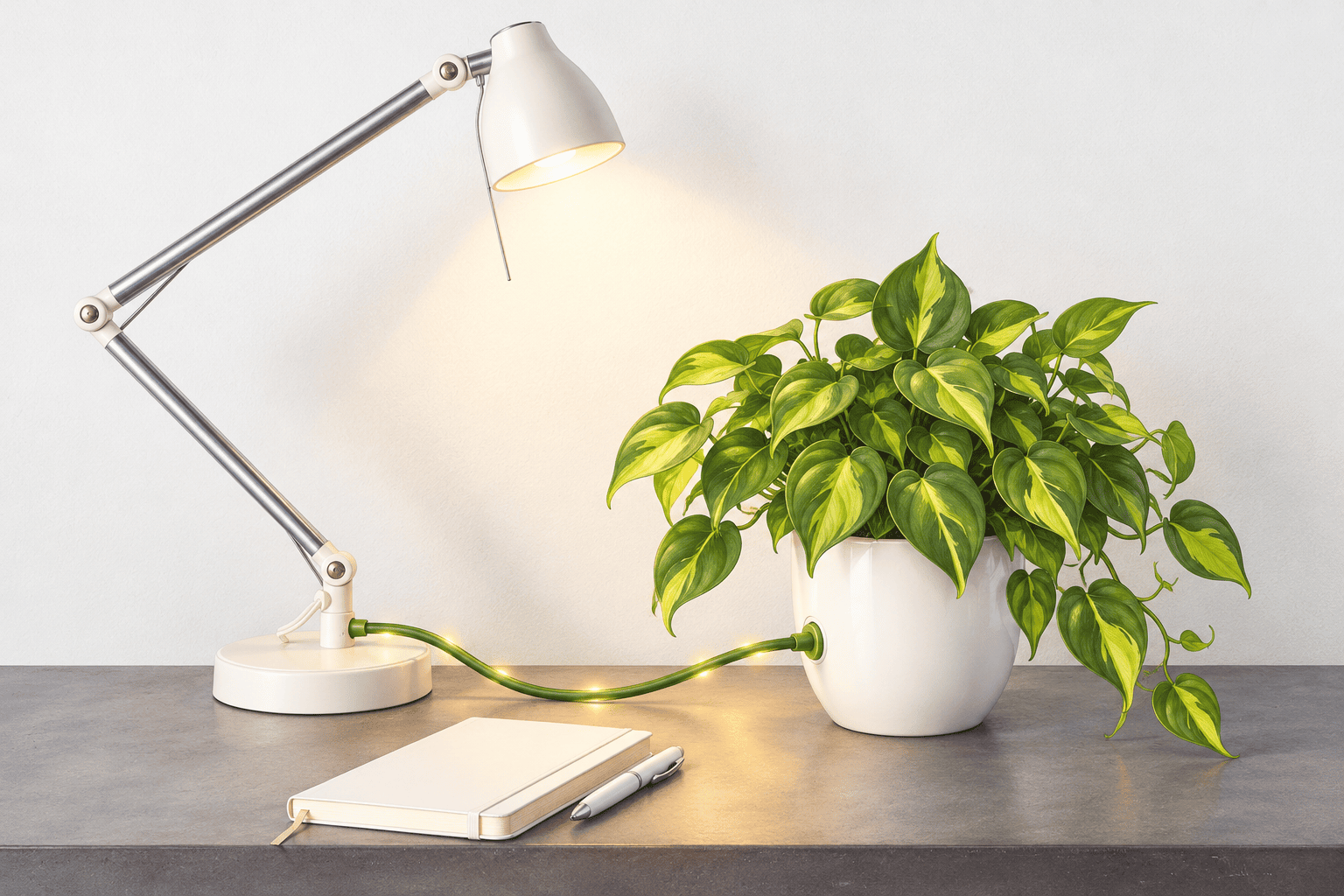
A single oleander leaf once lit up 100 LEDs. A sprig of watercress glowed in the dark for almost four hours. Both happened in research labs, and both raise a fair question: could the plants in your office one day power their own lights?
We spend most of our time thinking about how much light plants need indoors. This post flips that around and looks at what plants can give back.
Can Plants Power LED Lights?
Yes, in the lab. Researchers have used living plants to light LEDs, and other teams have made plants that glow on their own. Neither is ready to replace the fixtures in your office, but the science is real, and it says a lot about how plants work.
Do Plants Conduct Electricity?
They do, weakly. Plant tissue is mostly water carrying dissolved minerals, and salty water conducts current. A stem behaves like a soft, high-resistance wire.
Plants also make their own small electrical signals. Cells hold a tiny voltage across their membranes, and when a plant is cut, bent or burned, a wave of electrical change can travel through its tissues to trigger a defense response elsewhere. Scientists call these signals action potentials and variation potentials. The Venus flytrap snapping shut is the most famous example.
Can Plants Generate Electricity?
Plants already run on energy conversion. Photosynthesis turns sunlight into chemical energy by moving electrons around inside the leaf. Researchers have found three practical ways to tap a plant for usable power:
- Leaf contact (static) electricity. Rubbing or tapping a leaf builds charge on its waxy surface, the same effect as a balloon on your hair. The plant’s wet inner tissue carries that charge to an electrode in the stem.
- Roots and soil microbes. Plants leak sugars through their roots. Soil bacteria feed on them and release electrons, which electrodes in the soil can collect. This is called a plant microbial fuel cell.
- Photosynthesis itself. Biologists have wired into algae and plant cells to pull electrons straight from photosynthesis. This is the earliest-stage approach.
So, can plants produce electricity? Yes, but in small amounts, and only with engineered hardware attached.
The Leaf That Lit 100 LEDs
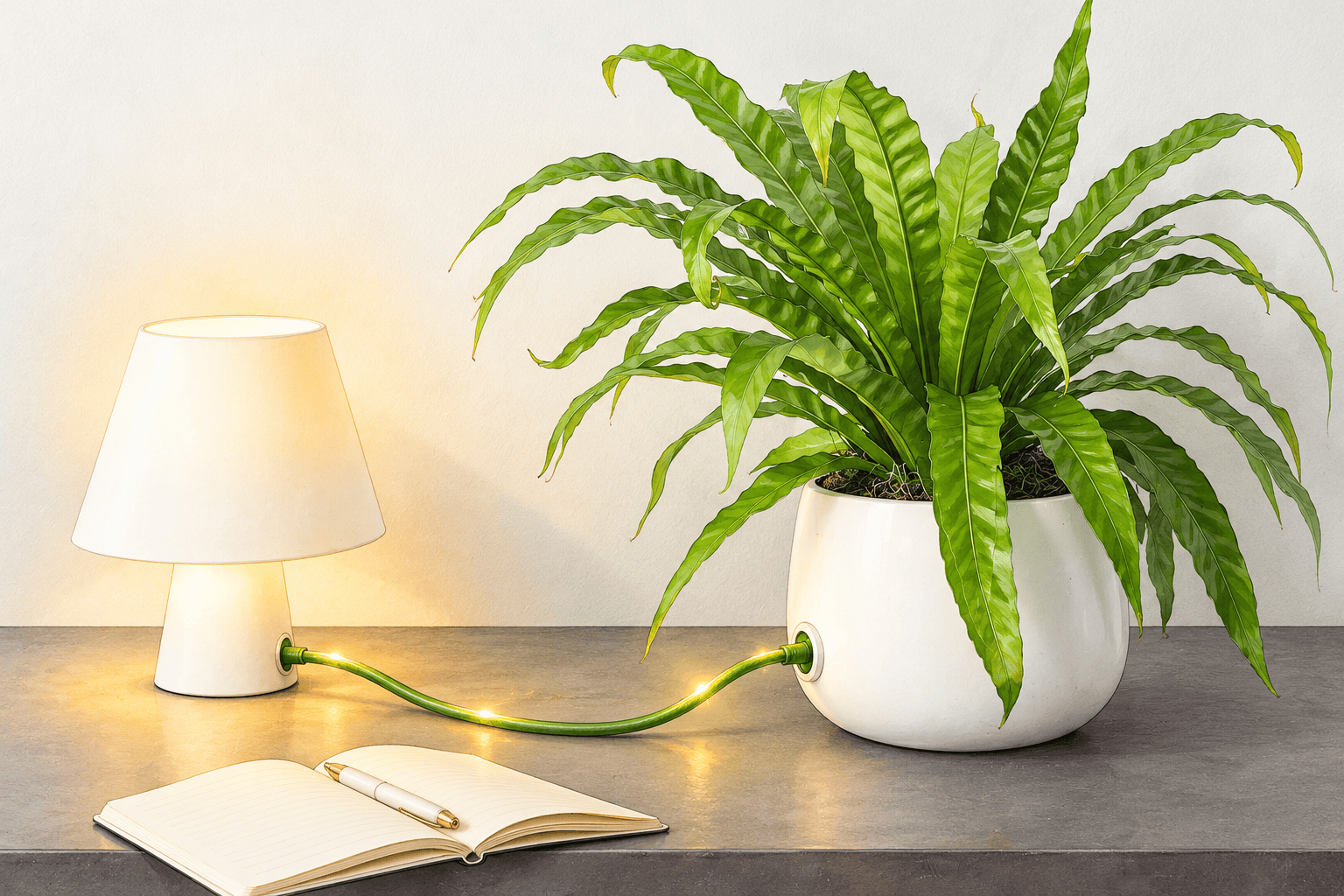
The most striking result came from the Center for Micro-BioRobotics at the Istituto Italiano di Tecnologia (IIT) in Pisa, Italy. In 2018, a team led by Barbara Mazzolai and Fabian Meder fitted an oleander (Nerium oleander) with artificial leaves made of soft silicone. When wind pushed the artificial leaves against the real ones, each touch produced a charge. A single leaf generated more than 150 volts, enough to flash 100 small LEDs (ScienceDaily; Advanced Functional Materials).
The trick is the plant’s own anatomy. The leaf’s outer layer collects the charge, and the tissue inside carries it to the stem like a cable, where an electrode harvests it. The team tested about 10 species and says the method could, in theory, work with almost any land plant. “For powering LEDs, it works very well,” Meder told The Wall Street Journal. “Now we have to find out whether it is a possibility outside the laboratory.”
Others are working the same angle. Researchers at the Chinese Academy of Sciences’ Lanzhou Institute of Chemical Physics used natural and artificial leaves to power LEDs and a watch. At the MIT Media Lab, Harpreet Sareen built a robotic flowerpot wired to its plant that moves the plant toward light when it needs it.
Plant Batteries
The classic science-fair “plant battery” (a lemon, potato or pickle with a copper and a zinc electrode) can light a small LED. But the energy comes from the metals reacting, not from the plant. The fruit or vegetable just supplies the salty, acidic liquid that lets current flow.
A living-plant battery is different. Dutch company Plant-e, a spin-off of Wageningen University, harvests electricity from plant roots and soil microbes in wetlands. Today it uses that power for self-sustaining field sensors that report soil moisture, groundwater and water quality.
Plants That Glow
If a plant can’t power a lamp, could it be the lamp? In 2017, MIT chemical engineer Michael Strano and his team published “A Nanobionic Light-Emitting Plant” in Nano Letters. They infused watercress with nanoparticles carrying luciferase, the enzyme that makes fireflies glow, plus the molecules it needs to light up.
The results, per MIT News:
- Watercress seedlings glowed for nearly four hours, up from about 45 minutes in early trials.
- The method also worked on arugula, kale and spinach.
- One 10-centimeter seedling gave off about one-thousandth of the light needed to read by.
- A second nanoparticle carrying a blocker could switch the glow off.
The plants glowed about 100,000 times brighter than earlier light-emitting plants made with genetically modified tobacco (Latin American Post). “The vision is to make a plant that will function as a desk lamp, a lamp that you don’t have to plug in,” Strano said. His team’s longer-term idea is trees that work as self-powered streetlights.
You can already buy a glowing plant. The Firefly Petunia from Light Bio uses genes from a bioluminescent mushroom to glow softly at night, powered by energy it stores through photosynthesis during the day. The USDA reviewed it and cleared it for sale across the U.S. The glow is real, but it’s visible only in a dark room.
Will Plants Light Your Office?
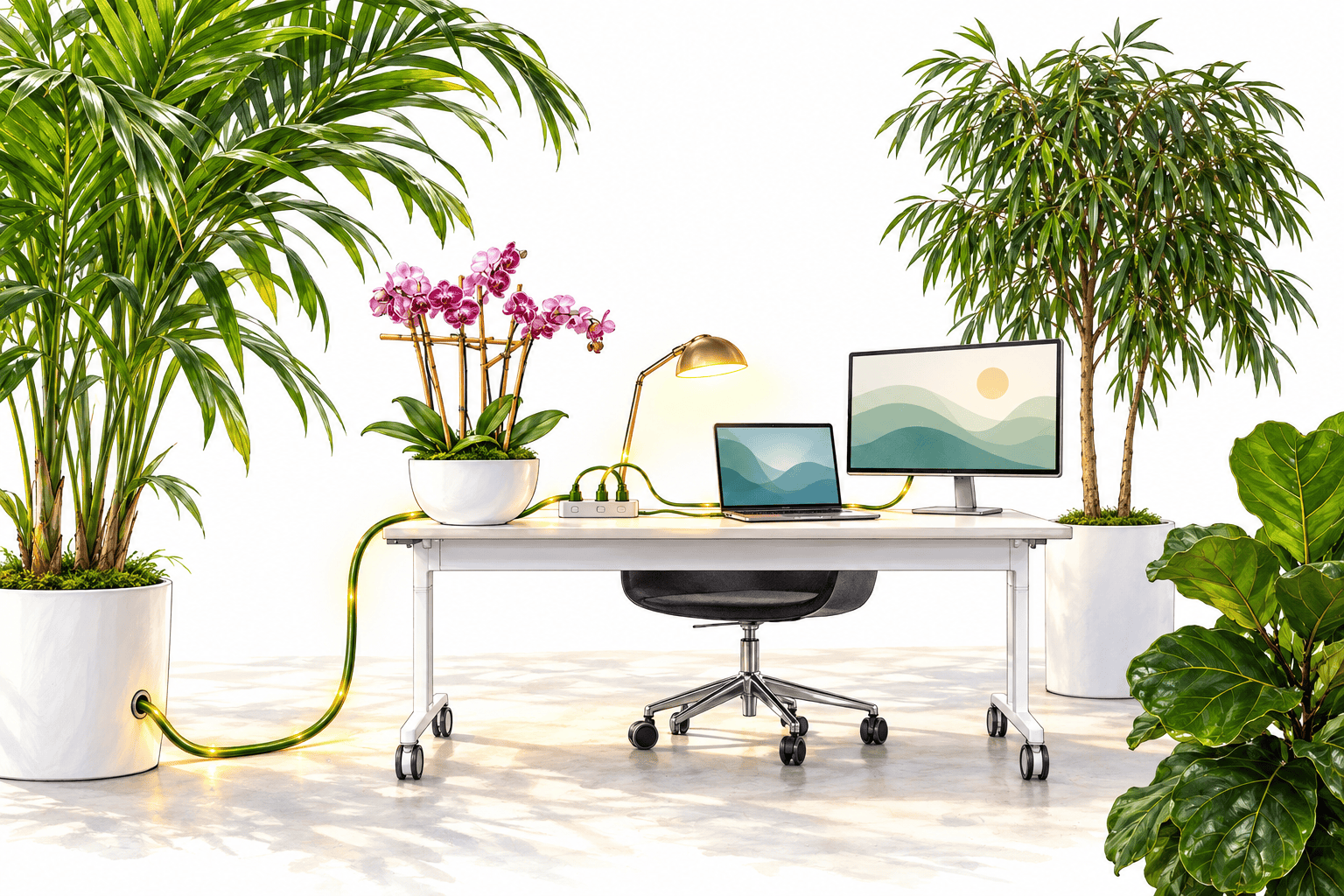
Not yet. Every one of these approaches produces small amounts of power or light, and most still live in research labs.
| Approach | What it has powered | Where it stands |
|---|---|---|
| Leaf contact electricity (IIT, Italy) | 100 LEDs in short flashes; LEDs and a watch (Lanzhou, China) | Lab research |
| Root and soil microbes (Plant-e) | Low-power field sensors | Commercial, niche |
| Nanobionic glowing plants (MIT) | Faint glow for about four hours | Lab research |
| Bioluminescent plants (Firefly Petunia) | Soft glow visible in darkness | Sold to consumers |
A high voltage like 150 volts sounds impressive, but it comes in brief pulses with very little current. That’s enough to blink an LED, not to run a light fixture. For now, the best use cases are remote sensors, educational displays and conversation pieces.
The bigger takeaway is what all of this reveals: plants are exceptionally good at converting light into energy. That’s exactly why light matters so much indoors.
Plants Run on Light
Every experiment above depends on one thing: a healthy plant. And a healthy plant depends on light. Even the glowing petunia needs a full day of light to store the energy it gives back at night.
Indoors, light is the factor that most often decides whether a plant thrives or slowly declines. Window exposure, glazing, ceiling height and fixture choice all change how much usable light reaches a leaf. A plant that looks fine for a few months can still be running a deficit.
That’s why we wrote the Planterra Lighting Guide for Interior Landscape Design. It covers:
- How to measure light and the difference between light for survival and light for growth
- Natural light through windows and skylights, and where to place plants
- Artificial and supplemental lighting for indoor landscapes
- Plant lists sorted by low, medium and high light tolerance
- Special considerations for living walls
If you’re planning a lobby, atrium or office and want to know how much light indoor plants need, the guide is free to download. Architects and designers use it early in a project, when lighting decisions are still easy to change.
Have a space in mind? Contact our team and we’ll help you match the right plants to the light you have.