




 Detroit, MI
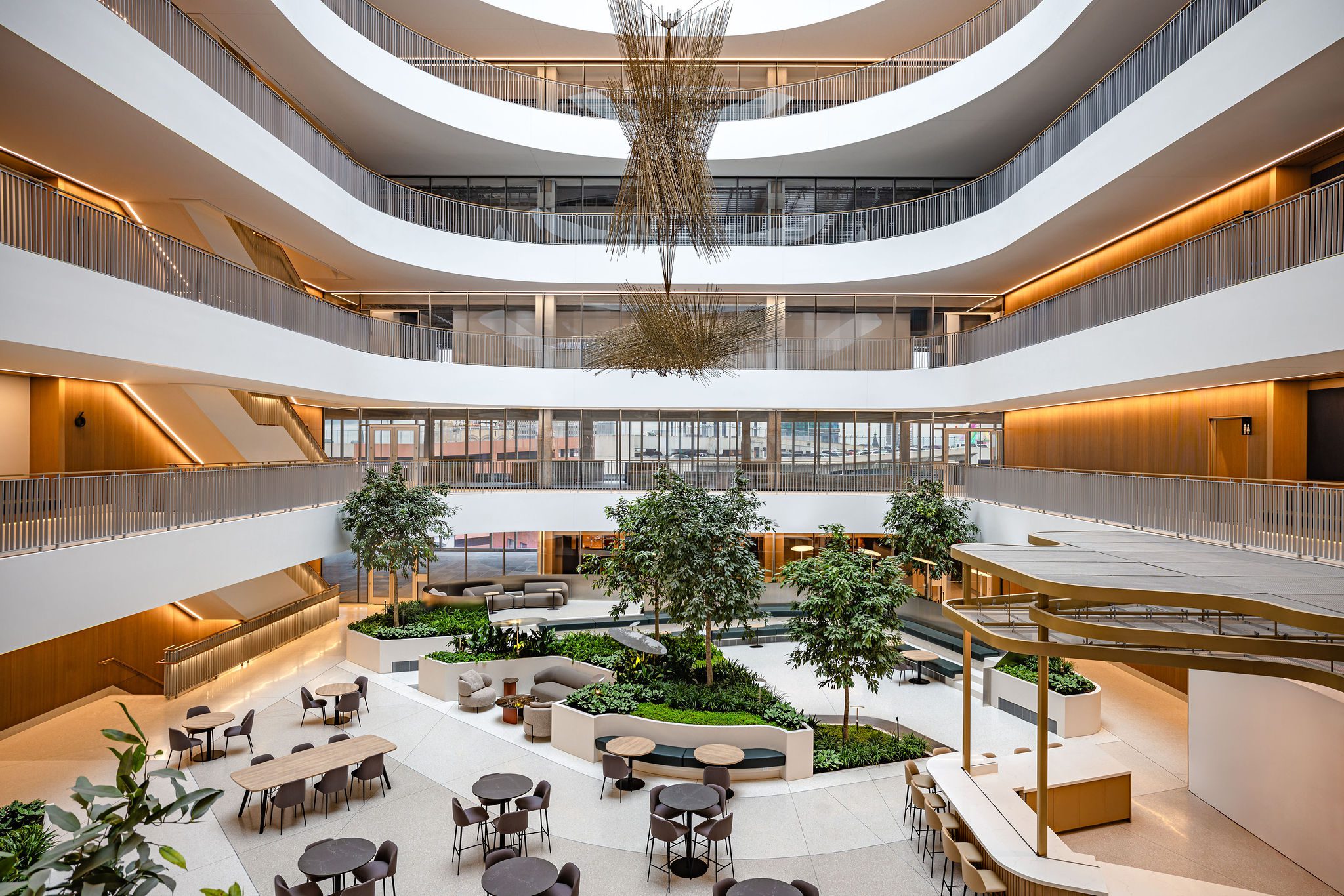
 Picture this: a 16-foot-tall tree, suspended by crane, being carefully guided through a temporary opening in a skyscraper, five stories above street level. This wasn’t a Hollywood stunt. This was a Tuesday morning last year at Hudson’s Detroit, where Planterra executed one of the most technically complex interior landscape installations in recent memory: a multi-layered plantscape anchored by nine towering trees and brought to life through carefully orchestrated coordination across seven stories of architectural space.
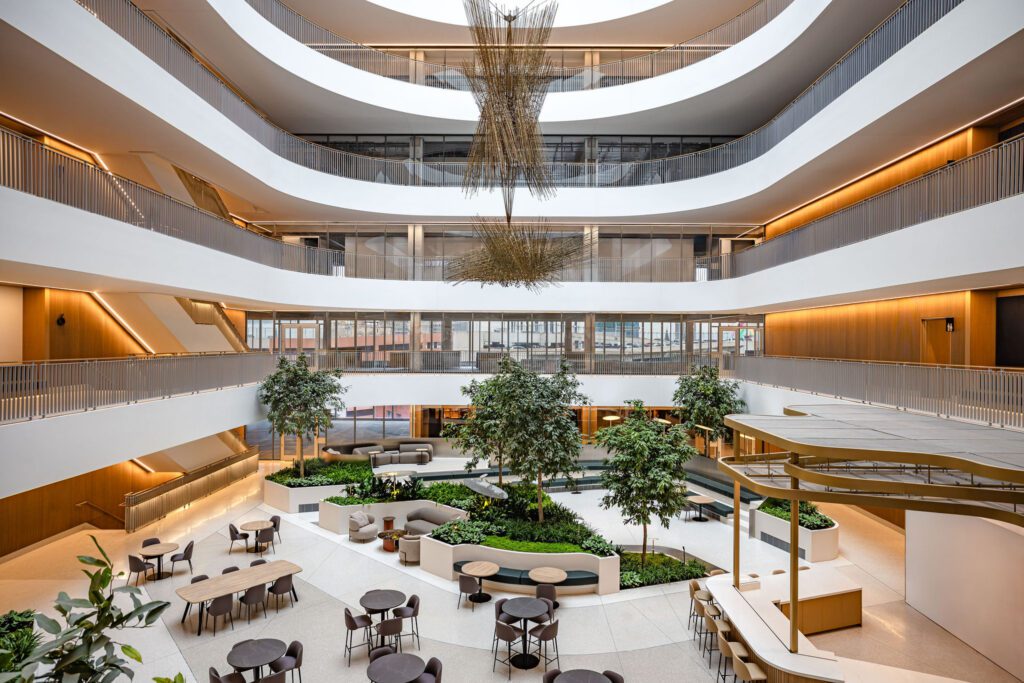
The completed seven-story atrium at Hudson’s Detroit featuring Planterra’s award-winning interior landscape installation. Photo courtesy of Bedrock.
We’re proud to announce that Planterra’s work at Hudson’s Detroit has earned the Platinum Award from the International Plantscape Industry Alliance at the 2026 International Plantscape Awards, the program’s highest honor. The Platinum designation recognizes projects distinguished by technical execution, design integration and long-term performance. But beyond the accolades, this project represents what’s possible when vision, precision and horticultural expertise converge in one of Detroit’s newest architectural landmarks.
Platinum Recognition for Interior Landscape Excellence
The International Plantscape Industry Alliance created the Platinum Award to recognize interior landscaping projects that go beyond aesthetics: installations that demonstrate technical mastery, seamless architectural integration and a commitment to enduring performance. The award was presented at the Let’s Get Tropical Soiree during the Tropical Plant Industry Expo in Fort Lauderdale, Florida, where projects from across North America competed for recognition.

“Partnering with Bedrock on Hudson’s Detroit presented an opportunity to be part of one of Detroit’s most significant modern developments,” said Shane Pliska, President and CEO of Planterra. “Executing an interior planting installation of this scale required disciplined planning, technical coordination and a long-term view of performance within a complex architectural structure. We’re proud of the role our team played in delivering an interior plantscape to endure.”
Winning Platinum validates not just this single project, but the approach we bring to every commercial plant installation: meticulous planning, technical problem-solving and an unwavering focus on how living systems will perform years after installation day.
The Challenge: Installing Plantscapes in Detroit’s First New Skyscraper in 50 Years
Hudson’s Detroit represents a watershed moment for the City. The building marks the first skyscraper constructed in Detroit in nearly 50 years, a symbol of renewal and a bet on the City’s future. The development is massive: a tower that will eventually rise to become one of the tallest buildings in Detroit, anchored by a 12-story block building that serves as the project’s foundation and retail hub.
Central to the design is a seven-story curvilinear atrium within that block building. Designed by SHoP Architects and Pophouse, the atrium functions as far more than an aesthetic flourish. It’s an architectural lightwell, engineered to draw natural daylight deep into the building’s core while creating a green sanctuary that supports wellness objectives and enhances the human experience of the space.
From an interior landscaping perspective, the atrium presented extraordinary challenges:
- Scale: Seven stories of vertical space requiring plantings that could hold visual presence without overwhelming the architecture
- Light conditions: Varying light exposure from full sun near the top to deep shade at ground level, requiring careful species selection across multiple zones
- Logistics: Active construction, no dedicated service elevators and structural constraints that made conventional installation methods impossible
- Integration: Coordination with design teams SHoP Architects and Pophouse, general contractors Barton Malow and Turner Construction, engineers and building management, all during one of the most complex construction timelines in recent Detroit history
We knew from day one: standard approaches wouldn’t work here. This project would require innovation at every phase.
How We Did It: Craning 16-Foot Trees Five Stories Into Hudson’s Detroit
The centerpiece of the installation came down to nine magnificent Ficus Amstel King trees, each standing 16 feet tall. These weren’t decorative saplings, they were mature specimens selected for their sculptural form, their ability to thrive in interior conditions and their capacity to anchor the atrium’s visual presence across seven stories of vertical space.
The problem? The trees were too tall to fit in freight elevators. The building was still under construction, fully enclosed, and five stories separated street level from the atrium floor.
The solution required precision engineering, creative problem-solving, and nerves of steel.
Working with Bedrock and the construction teams, we orchestrated a carefully choreographed operation:
- A section of windows was temporarily removed on the fifth story, creating an opening large enough to receive the trees
- Each tree was secured in a custom rigging system designed to protect branches, root balls and structural integrity during the lift
- A mobile crane positioned on the street below lifted each tree five stories up and guided it through the opening with millimeter precision
- Our horticultural team received each tree inside, immediately beginning acclimation protocols to minimize transplant shock
The operation required extensive coordination across structural, logistics and horticultural teams to execute safely.
But the crane operation was just the beginning.
Beyond Installation: Interior Landscaping Built for Long-Term Performance – Months of Acclimation and Care
Trees positioned in the Hudson’s Detroit atrium during the acclimation phase prior to understory planting. Photo: Planterra
The trees arrived during active construction: dust, temperature fluctuations, limited access, noise and ongoing structural work. Our team provided continuous monitoring and care before we could even begin installing understory plantings. This acclimation period was critical. We tracked:
- Soil moisture and irrigation performance
- Light exposure as the building envelope was completed
- Temperature and humidity fluctuations
- Foliage response and signs of stress
- Root establishment in the custom planting beds
This phase embodied our philosophy: interior landscaping excellence isn’t about installation day. It’s about what happens in month six, year two and decade one.
Designing the Understory: A Layered Living System
The design team’s vision called for sculpted, mounded planting beds, an organic, naturalistic approach that would contrast beautifully with the atrium’s clean architectural lines. We worked closely with the architects and interior designers to translate that vision into a resilient plantscape that could perform across dramatically varying light conditions.
Our approach was layered and strategic:
- Deep shade zones (ground level, interior edges): Low-light-tolerant species that could thrive with minimal direct sun while providing lush, anchoring foliage
- Medium-light transition zones: Species selected for adaptability, creating visual flow between the shade and brighter areas
- Higher-light zones (planting bed edges, areas closer to the atrium’s upper levels): Species that reinforce visual depth and bring brightness to the composition
“We chose species that could deliver on two fronts: visual impact across multiple stories and proven resilience in interior conditions,” said Sarah Stalker Alyward, Creative Director at Planterra. “These aren’t decorative plants—they’re workhorses selected for their ability to thrive long-term in challenging light gradients.”
The result is a cohesive interior landscape that complements the atrium’s architectural scale while remaining resilient as the building transitions to full occupancy. Every plant was chosen not just for how it looks on day one, but for how it will perform as the living system matures.
Horticultural Care: The Invisible Infrastructure
Equally critical to the project’s success is the long-term horticultural care strategy we developed for Hudson’s Detroit. This is a comprehensive maintenance program designed to support plant health, visual continuity and system performance over time.
Our care strategy includes:
- Customized irrigation protocols tailored to each microclimate within the atrium
- Seasonal adjustments to account for changing light angles and building occupancy patterns
- Integrated pest management using sustainable, building-safe methods
- Soil health monitoring to ensure long-term nutrient availability
- Canopy management to maintain the trees’ sculptural form as they mature
- Replacement and rotation protocols for understory plants to ensure perpetual visual impact
This approach ensures the interior landscape evolves alongside the building, reinforcing its role as a defining feature of the Hudson’s Detroit experience for years to come.
What This Award Means for Interior Landscaping
The Platinum Award from the International Plantscape Industry Alliance is truly an honor, a recognition that interior landscaping has evolved into a sophisticated technical discipline. It’s no longer just about putting plants in buildings, rather, t’s about integrating living systems into architectural projects with the same rigor, precision and long-term thinking that goes into HVAC, lighting and structural systems.
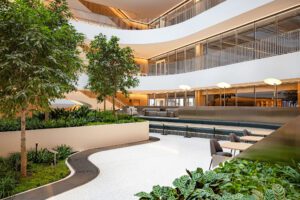
The completed multi-layered plantscape with understory species throughout the seven-story atrium. Photo courtesy of Bedrock.
At Planterra, we’ve spent more than 50 years refining our approach to commercial plant installation. We’ve built the largest service coverage network in the United States specifically so we can deliver not just beautiful installations, but ongoing horticultural care that ensures those installations perform year after year. We work with Fortune 500 companies, corporate campuses, hospitality destinations and retail brands, and with architects and developers who understand that biophilic design is a fundamental component of human-centered architecture.
Hudson’s Detroit is a testament to what’s possible when you treat interior plantscapes as permanent, integrated building systems. When you plan for the crane lift and the year-ten pruning with equal care. When you select species based on decades of performance data, not just catalog photos. When you build partnerships with world-class architects, developers and construction teams who share a commitment to excellence.
Transforming Spaces with Living Systems
The seven-story atrium at Hudson’s Detroit will welcome thousands of visitors, workers and residents in the years ahead. They’ll experience natural light filtering through the canopy. They’ll see green space where they expected concrete and glass. They’ll feel the subtle but measurable benefits of biophilic design: reduced stress, improved air quality and enhanced well-being.
Most won’t know about the crane lifts, the four months of acclimation or the sophisticated care protocols happening behind the scenes. And that’s exactly the point. The best interior landscaping becomes part of the architecture…seamless, enduring and alive.
We’re honored to have played a role in bringing Hudson’s Detroit to life and grateful for the recognition from the International Plantscape Industry Alliance. But mostly, we’re excited about what this project represents for the future of interior landscaping: ambitious, technically sophisticated and built to last.
Ready to Transform Your Space with Award-Winning Interior Landscaping?
Whether you’re planning a corporate headquarters, a hospitality destination or a mixed-use development, Planterra is the leading provider of interior plantscape services in Detroit. We bring more than 50 years of expertise in designing, installing and maintaining interior landscapes that perform. From initial concept through decades of ongoing care, we partner with architects, developers and corporate clients to create living systems that enhance the built environment.
Contact us to explore how interior landscaping can transform your next project.